English
Meta Enterprise Platform: who runs it and what you can use today

CJ Desai ran MongoDB for 322 days. On September 28, 2026, he stepped down as its president and CEO to lead Meta Enterprise Platform, a business that Meta announced the same day. Mark Zuckerberg’s post calls it “the next major pillar of our business”.
MongoDB’s press release says Desai left “effective immediately”. The company’s filing with the U.S. Securities and Exchange Commission (SEC) says he gave notice four days earlier. The board chose his interim replacement two days before the public heard.
The filing, Desai’s offer letter and Meta’s developer pages fill in what the two announcements leave out. This piece starts with what Meta Enterprise Platform consists of today and what its API costs. It then follows the dates at MongoDB, which released version 9.0 of its database the day after its CEO left.
Advertisements
Meta Enterprise Platform starts with a leader and four existing products
The announcement is short: one statement from Zuckerberg and one from Desai. Desai joins as Chief Enterprise Platform Officer, “reporting directly to me”, Zuckerberg writes.
The first job, in Zuckerberg’s words, is to bring Meta’s technology, “including the Muse agent, Meta Business Agent, Muse API, Muse Code, and more”, to businesses and developers. Desai describes the goal as “turning its AI stack into products and services that companies can deploy for their own businesses”.
By our count, the post has no price, no launch date and no new product name other than Meta Enterprise Platform. So we looked up the four names it does give on Meta’s own pages, eight days after the announcement. Each row of the table is one of them, with the status and the price that Meta publishes.
Advertisements
| In the announcement | On Meta’s pages | Status | Price |
|---|---|---|---|
| the Muse agent | Muse, “a personal AI agent” | Launched September 8, 2026; a post of September 29, 2026 calls it “available in the US and Canada” | “free for most of what people need”, with subscription plans |
| Meta Business Agent | Meta Business Agent, on WhatsApp, Messenger and Instagram | Announced June 3, 2026 | “getting started is free”; since September 15, 2026, Meta One creator and business plans with more agent use start at $14.99 a month |
| Muse API | Meta Model API | “Public preview. Now available with expanded global access.” | $1.25 input and $4.25 output per million tokens of Muse Spark |
| Muse Code | Muse Code, a coding agent for the terminal | Out of beta since August 31, 2026 | $5.00, $15.00 or $50.00 a month, or per token |
All four were public before the announcement
Read the Status column. Three of the four rows carry a date before September 28, 2026.
The fourth, the API, gives no date: its product page calls it a public preview. It is older than the announcement as well. A Meta blog post of August 31, 2026 already tells readers to sign in “with your Meta Model API account”.
Muse is a personal agent, and Business Agent answers customers
The four products don’t share an audience. Meta calls Muse “a personal AI agent”. Meta added Muse for Small Business on September 29, 2026, the day after the enterprise announcement.
The Meta Business Agent post is the one that already talks to large companies. It introduces a Meta Business Agent Platform with “enterprise-grade controls, guardrails, and measurement” for businesses that want to build their own agent.
Advertisements
That June post promised “paid subscription offerings” for the agent. On September 15, 2026, Meta introduced Meta One, a subscription service whose creator and business plans include “more access to Meta Business Agent”. They start at $14.99 a month, and the largest starts at $499.
The Meta One post links the agent’s name to the June announcement, and it doesn’t say whether these are the plans promised there. It adds that plans and pricing “may vary by region, by app, and by account”.
The docs call the Muse API the Meta Model API
“Muse API” is a name that Meta’s developer docs don’t use. We searched the 99 pages linked from the docs menu for the phrase and found it in none of them.
Advertisements
What the docs describe is the Meta Model API. By our reading, that is the product the announcement means. The overview says Muse Spark, Meta’s text model, “is served through Model API”, and that Muse Code shares “same models, same auth, same billing” with it.
The word “enterprise” is on two of the 99 pages, both about Muse Code. The configuration page says: “Enterprise administrators can validate a managed configuration document”. The name Enterprise Platform is on none of them.
Muse Spark costs $1.25 in and $4.25 out per million tokens
The pricing page bills Muse Spark at $1.25 per million input tokens and $4.25 per million output tokens. Versions 1.1, 1.2 and 1.3 share that price.
Advertisements
The chart puts those two numbers beside Claude Sonnet 5.5 and GPT-6.1 Sol, two API models that cost $2 and $10 and that this site’s news section covered. Each price comes from the vendor’s own page: Meta’s, Anthropic’s and OpenAI’s, in its short-context tier.
The chart compares list prices and nothing else.
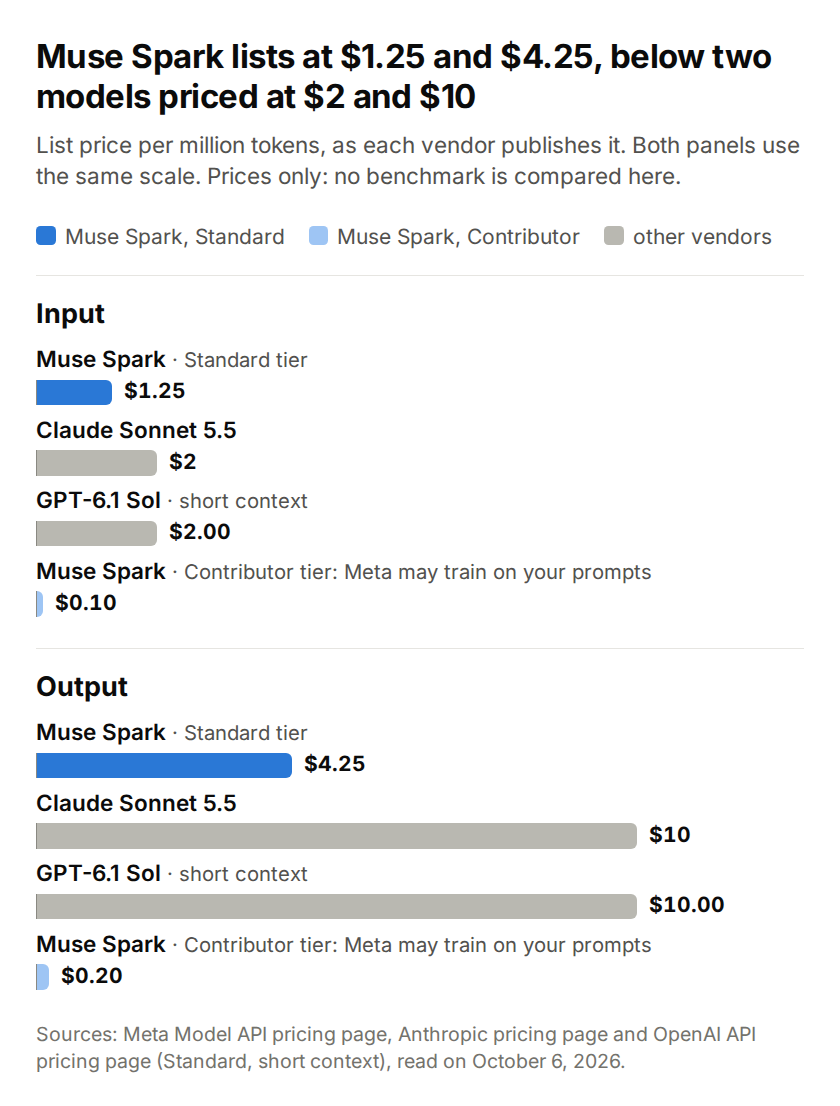
Muse Spark’s output price is less than half of the other two, $4.25 against $10. Its input price is $1.25 against $2.
Meta’s page adds: “There is no long-context premium”. OpenAI’s table has one: for GPT-6.1 Sol, input goes from $2.00 to $4.00 in the long-context tier. Anthropic’s card for Sonnet 5.5 shows one input price.
Advertisements
The models page gives Muse Spark a context window of 1,048,576 tokens.
Price is also the argument of one outside analysis. MBI Deep Dives, an investor newsletter, wrote on September 29, 2026 that Meta has to be “a credible alternative at a lower price” for the enterprise push to work.
A second tier trades price for training data
The $1.25 and $4.25 are the Standard tier, where “your prompts and completions are not used to train Meta models”. Meta also sells a Contributor tier at $0.10 input and $0.20 output. That discount is “in exchange for permission to use your prompts and completions to train future Meta models”.
The tier is part of the model ID. muse-spark-1.3 is Standard and muse-spark-1.3-contributor is Contributor, so one string in your configuration decides whether Meta can train on what you send.
Advertisements
The two tiers also differ in rate limits. Standard allows 3,000 requests and 4,000,000 tokens per minute. Contributor allows 100 requests per minute.
Existing OpenAI and Anthropic clients connect to it
You don’t need a new client library to try it. The quickstart describes the API as “drop-in compatible with the OpenAI SDK, the Anthropic SDK”, with a base URL of https://api.meta.ai/v1.
Muse Code is the second way to use the same model. Meta took it out of beta on August 31, 2026 and added the three monthly plans, which the product page prices at $5.00, $15.00 and $50.00. The subscriptions page warns: “Subscription benefits and availability may vary by region.”
Advertisements
The docs point new users to two different versions. The models page marks Muse Spark 1.3 as “Recommended for new work”, and the Muse Code page says: “The default model is muse-spark-1.2.”
Desai gave notice four days before the announcement
MongoDB’s press release dates everything to September 28. Its Form 8-K, the report a U.S. public company files after a major event, has two earlier dates.
On September 24, 2026, the filing says, Desai “notified the Company of his intent to resign”, effective September 28. On September 26, 2026, a Saturday, the board appointed Dev Ittycheria as interim president and CEO. The filing adds that the resignation is “not due to any disagreement with the Company”.
Advertisements
The timeline puts those dates in order with the ones from MongoDB’s other filings and press releases. Follow the marks from September 24 to September 29.
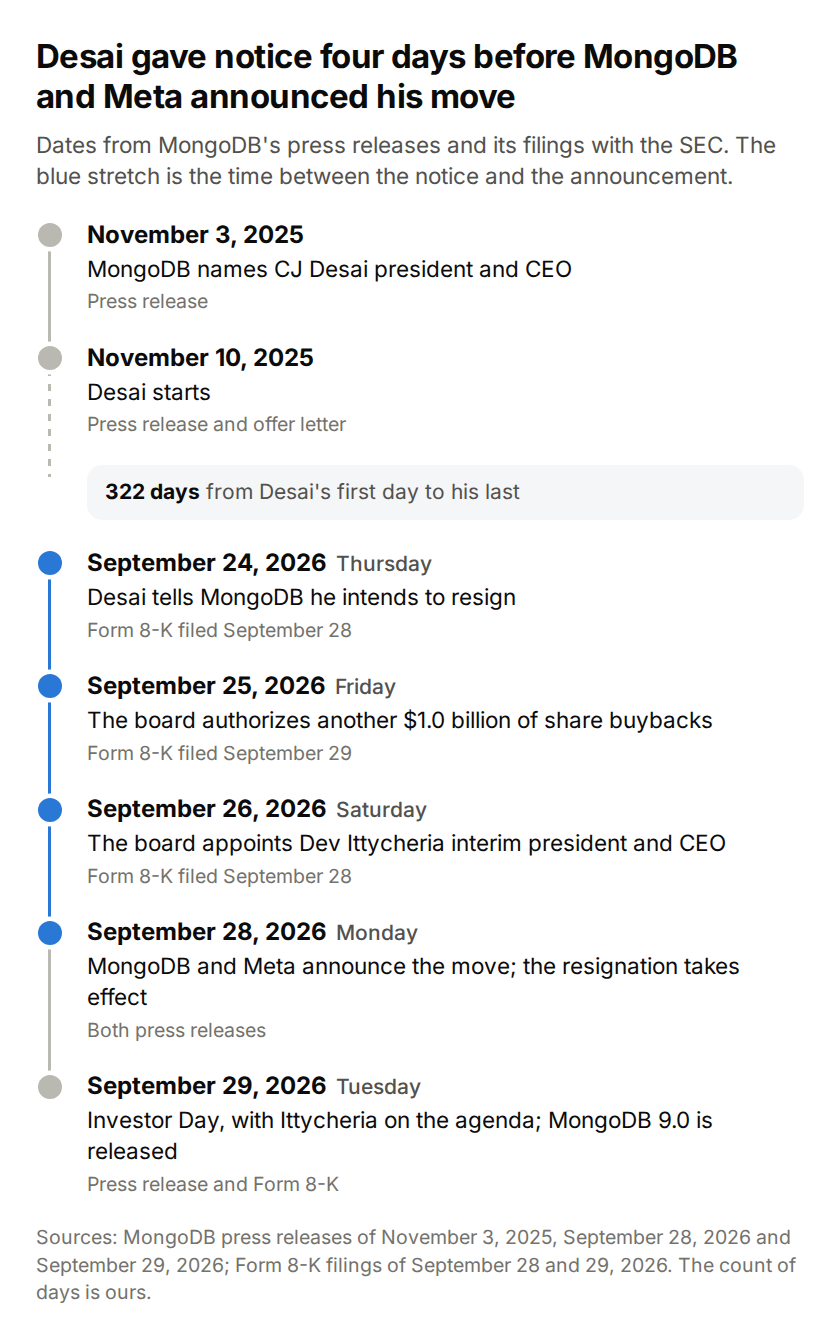
Two of the marks fall between the notice and the announcement: a share buyback and the choice of the interim CEO.
The buyback comes from a second 8-K, filed on September 29. It says that on September 25, 2026 the board “authorized an additional $1.0 billion in repurchases” of MongoDB’s own shares. The program now totals $2.0 billion.
Advertisements
The offer letter sets no notice period for an ordinary resignation
On Hacker News, one commenter asked whether “he gave notice and it wasn’t announced to the world until his last day”. The 8-K answers yes. Nobody had replied to the question when we read the thread.
Another commenter pointed to Desai’s offer letter, which is on file with the SEC, and wrote: “As far as I can tell, there is no notice period.”
We read the letter, dated October 29, 2025. It calls the employment “at-will”. We searched it for the word “notice” and found no notice period for an ordinary resignation, which matches the commenter’s reading.
Advertisements
It does set a deadline for a resignation for “Good Reason”: written notice within 30 days of the cause.
The letter does say what a resignation costs: “you will no longer vest in any equity awards”, and “you will not be entitled to any severance benefits”. It also set a $2,500,000 sign-on bonus in two halves, the second “following twelve months of continuous service”.
Desai started on November 10, 2025, a week after MongoDB named him, and left in his eleventh month. No document we read says what Meta is paying him.
MongoDB’s stock closed 18.5% lower that day
TechCrunch reported that MongoDB’s shares “dropped by more than 17%” on the news. Nasdaq’s historical data has the closing prices: $410.44 on Friday, September 25, and $334.68 on Monday, September 28.
Advertisements
By our arithmetic, that is a fall of 18.5%. On October 5, 2026, the last close before we wrote this, the stock was at $359.23.
MongoDB shipped 9.0 the next day, with Ittycheria back in charge
The resignation came one day before MongoDB’s Investor Day, held on September 29, 2026 in New York. MBI’s analysis notes that Desai left “a day before his own investor day”.
The event went ahead, with Ittycheria on the agenda as interim CEO. The presentation that MongoDB filed with the SEC has “CEO Transition Comments and Q&A” as the second item of its agenda. One of his slides lists “Find my successor” among his priorities.
Advertisements
The product news of that day is in three press releases. The first says: “MongoDB 9.0 is generally available today”. It also opens a public preview of Atlas Infinite, a new way to deploy Atlas, MongoDB’s cloud service, that “separates compute from storage”.
The preview “is available now in Public Preview on AWS”, with other clouds “planned for the future”. The same release renames the Atlas that exists today to Atlas Core.
MongoDB claims “Up to 35% faster find-one queries” and “Up to 2x throughput on large instances” for 9.0. Those are the vendor’s numbers, and a footnote says what they compare with: “Benchmark data compared to MongoDB 8.0”.
Advertisements
The second release opens a public preview of Atlas Agent Engine, “a unified execution, memory, and governance layer for production AI agents”. The third announces Devin for MongoDB Modernizations, a migration product built with Cognition.
The interim CEO held the job for eleven years
Ittycheria was MongoDB’s president and CEO from 2014 to 2025 and has stayed on its board. The 8-K gives his age as 59 and says that since September 2026 he is also “a Partner and Senior Advisor at Sequoia Capital”.
The September 28 press release says the board “has retained an executive search firm” to find a permanent CEO. It also says MongoDB is “reaffirming its guidance for Q3 and the full year fiscal 2027”.
Advertisements
The previous search ended less than eleven months earlier. The release of November 3, 2025 says Desai’s appointment came after “a comprehensive CEO search supported by an executive search firm”.
If you build on MongoDB or on Meta’s API
This section is our reading of the documents above.
For MongoDB users, the two documents about the CEO change, the press release and the 8-K, announce no product change. The product changes of that week are the ones MongoDB launched on September 29: version 9.0, two previews, a new name for the existing Atlas and the migration product with Cognition. If you plan around Atlas Infinite, the limit to check is the cloud: the preview runs on AWS.
On Meta’s side, Meta Enterprise Platform is so far a division and an executive. The API to call is the one that was already there: a public preview, priced below the two models in the chart. If you test it, check the model ID first, because the -contributor suffix gives Meta your prompts for training.
Advertisements
Wait for the enterprise part before you plan on it. In the docs, the word “enterprise” appears only for a managed configuration of Muse Code.
Two questions the announcements leave open
Meta’s post doesn’t say what Meta Enterprise Platform sells beyond the four products that already exist, or at what price. MongoDB’s documents don’t name a permanent CEO or a date for the choice. Watch for a new Form 8-K from MongoDB and for a change on Meta’s pricing pages.
Related posts:
 Google Cuts One-Third of Managers in Move to Streamline Its Organizational Structure
 A New DeepSeek Paper Highlights the Growing Push for More Efficient AI Training
 OpenAI Launches ChatGPT Health: New AI Tool Focused on Healthcare with Reinforced Privacy
 Claude Cowork: Anthropic Introduces an AI Agent That Works Directly With Your Files
 Claude Opus 5.5 vs GPT-6 Sol and Luna: prices, benchmarks, platforms
 Claude Sonnet 5.5 vs Opus 5.5: cost per task, where each fits