English
Gemini 4 Argon: announced at $2 and $10, not in the API yet

Gemini 4 Argon, the model Google announced on September 30, 2026, isn’t open to developers. It is rolling out to “a set of trusted cyber defenders” through the Fairwind Program, Google’s limited access program for cyber defense. Google’s post gives two prices and no date: $2 per million input tokens and $10 per million output tokens at first, $4 and $20 later.
Google promises access for “developers, enterprises, and consumers as soon as possible”, starting with paid API customers and Google AI Ultra subscribers. Ars Technica wrote the same day that Google “isn’t making any specific timeline promises”.
The first two sections cover who has the model and what Google says it has done. The rest answer three questions for anyone planning around it.
Advertisements
Which Gemini models does the API list today? What do Argon’s two prices line up against? And how does Google’s benchmark table read next to leaderboards that publish a cost?
Gemini 4 Argon is rolling out through the Fairwind Program
Google opened the Fairwind Program on September 2, 2026 as “a limited access program for governments and trusted partners”. The program page counts over 650 partners. It names three groups Google prioritizes: governments and national cyber authorities, critical infrastructure operators, and core technology platforms.
The page says a set of those partners gets Argon, and the terms restrict the model to a partner’s internal cybersecurity, incident response or penetration testing teams. Partners can’t share, redistribute or sell access.
Advertisements
Google says these defenders and its own internal teams get Argon “without cyber guardrails”. The announcement also thanks “the initial cohort of cyber defenders and trusted testers”, and it doesn’t say who the testers are.
If your organization isn’t eligible, the page points you to CodeMender, Google’s code security agent, “with publicly available models”. Academic labs that work on defensive benchmarking can apply.
Before a broad rollout, the announcement says, Google is strengthening safeguards in four areas: misuse, prompt injection, misalignment monitoring and the sandboxes it tests models in. It adds that Google is “actively engaged in the U.S. government’s voluntary process for pre-release model access”.
Advertisements
Google cites internal use and one Wiz finding
The examples of what Argon has done come from the announcement. It says a team of Argon agents found memory optimizations for Google’s data centers that free “over 300 TiB of memory once rolled out”.
It also says Argon agents are migrating C/C++ code to Rust, in jobs that go “up to 800K+ lines for the Fuchsia Zircon kernel”. Those rewrites are still under review before they reach production.
The one outside example is Wiz. Google says Wiz used Argon to find a critical vulnerability “across healthcare software used by hospitals worldwide”. Ars Technica notes that Google “didn’t provide any specifics” about the flaw.
Advertisements
The Gemini API pages do not list Argon
We read Google’s developer pages on October 2, 2026. The Gemini API’s models page, pricing page and release notes have no Argon entry, and the newest release note is dated September 22, 2026.
Google Cloud’s model list and release notes for Gemini Enterprise Agent Platform have none either. The Cloud notes for September 30 add xAI’s Grok 4.7 in preview.
Two models the API serves today sit beside Argon below. Gemini 3.8 Flash is the one the models page calls “Our most intelligent Flash model”. Gemini 3.1 Pro is the highest-numbered Pro model for text on that page, and it is still a preview.
Advertisements
Prices are per million tokens, from the Gemini API pricing page for the first two and from the announcement for Argon.
| Gemini 3.8 Flash | Gemini 3.1 Pro | Gemini 4 Argon | |
|---|---|---|---|
| Status | Stable | Preview | Not listed; Fairwind partners and testers |
| Input | $0.75 through December 31, 2026, then $1.50 | $2.00 for prompts up to 200k tokens | $2 introductory, then $4 |
| Output | $3.75 through December 31, 2026, then $7.50 | $12.00 for prompts up to 200k tokens | $10 introductory, then $20 |
Compare the last two columns. Argon’s introductory input price equals Gemini 3.1 Pro’s $2.00, and its introductory output price is lower, $10 against $12.00. At the later price, Argon’s input costs twice the Pro preview’s, $4 against $2.00.
The announcement gives the output limit, and the recap gives the context window
Google’s post also gives an output limit: 1M tokens, “up from the previous 64K tokens”. It doesn’t state an input limit.
Advertisements
On Hacker News, a commenter asked “what about input?” and, after one reply, added: “Just seems odd not to say what it is.”
Google’s September recap, published on October 2, 2026, describes Argon as built with “a 1-million-token context window”. For comparison, the Gemini 3.8 Flash page on Google Cloud lists a context window of 1,048,576 tokens and a maximum output of 65,536.
The two prices match Sonnet 5.5 and GPT-6.1 Sol, then Opus 5.5
The figure groups the models by price per million tokens, each taken from the vendor’s own page. Those pages are the announcement for Argon, Anthropic’s pricing page and OpenAI’s API pricing, in its short-context tier. Cached input is the rate for reading back a prompt the API has already stored.
Advertisements
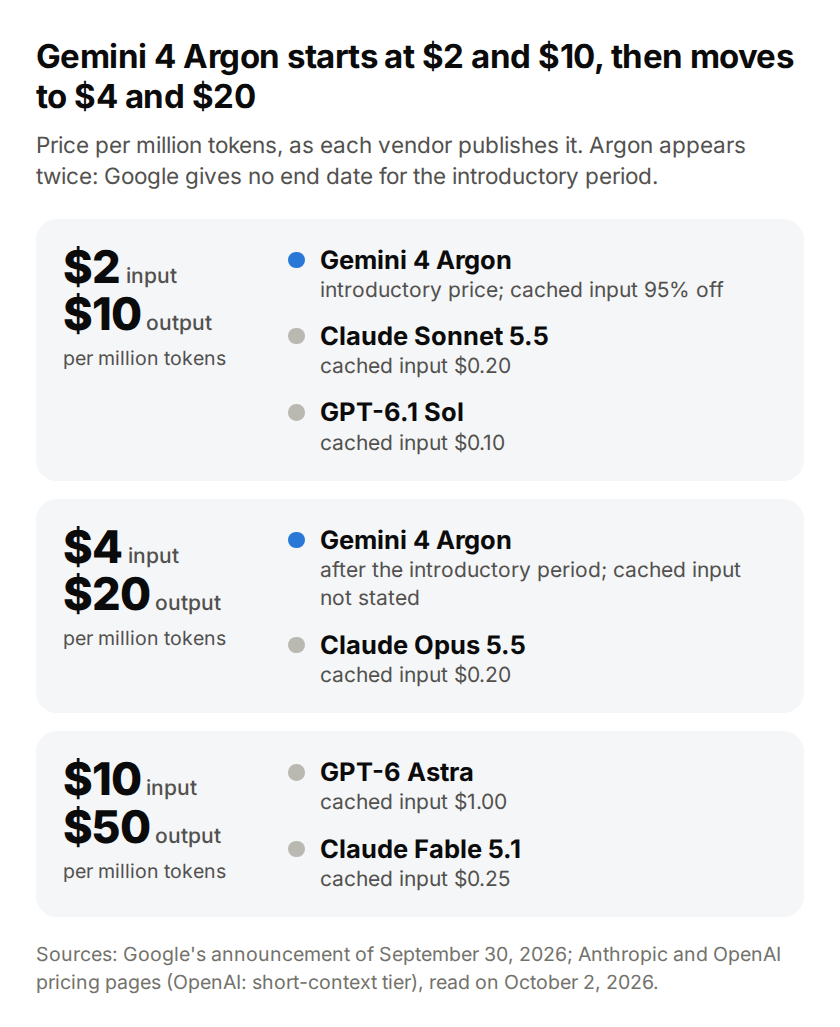
The introductory price is the list price of Sonnet 5.5 and of GPT-6.1 Sol, the last two model launches our News section covered. The later price, $4 and $20, is Opus 5.5’s.
GPT-6 Astra and Claude Fable 5.1, two of the three models Google benchmarks Argon against, list at $10 and $50.
The cached rate is a percentage, and one leaderboard used another figure
Google’s post gives the cached rate as a percentage. By our arithmetic, 95% off $2 is $0.10, which is GPT-6.1 Sol’s rate and half of Sonnet 5.5’s $0.20.
Advertisements
CWE-bench, a cybersecurity benchmark whose leaderboard has an Argon row, used a different figure. It says it priced Argon’s tokens at $2 input, $0.20 cached input and $10 output. The $0.20 and our $0.10 don’t match, and the announcement has no dollar figure to settle it.
The footnote that sets the later price names input and output only, so we can’t tell whether the discount carries over. The announcement also gives no end date for the introductory period.
Google’s table has three rivals, and Argon trails in five rows
The benchmark table on Google DeepMind’s model page has 19 rows and four model columns: Gemini 4 Argon, GPT-6 Astra, Claude Fable 5.1 and Claude Opus 5.5. Sonnet 5.5 and GPT-6.1 Sol, the two models at Argon’s introductory price, aren’t in it.
Advertisements
The methodology note says Google ran Argon “with the highest thinking settings” unless stated otherwise. For the other models it used “providers’ self reported numbers”, public leaderboards or, on some benchmarks, its own runs.
By our count, Argon has the highest score alone in 13 of the 19 rows and ties GPT-6 Astra in one, CWE-bench v1, at 68.0%. It trails another model in the other five.
The chart has one mark per row. A bar’s length is the distance, in percentage points, between Argon’s score and the best score among the other three models, and a dot marks the tie. The scores are Google’s and the subtraction is ours.
Advertisements
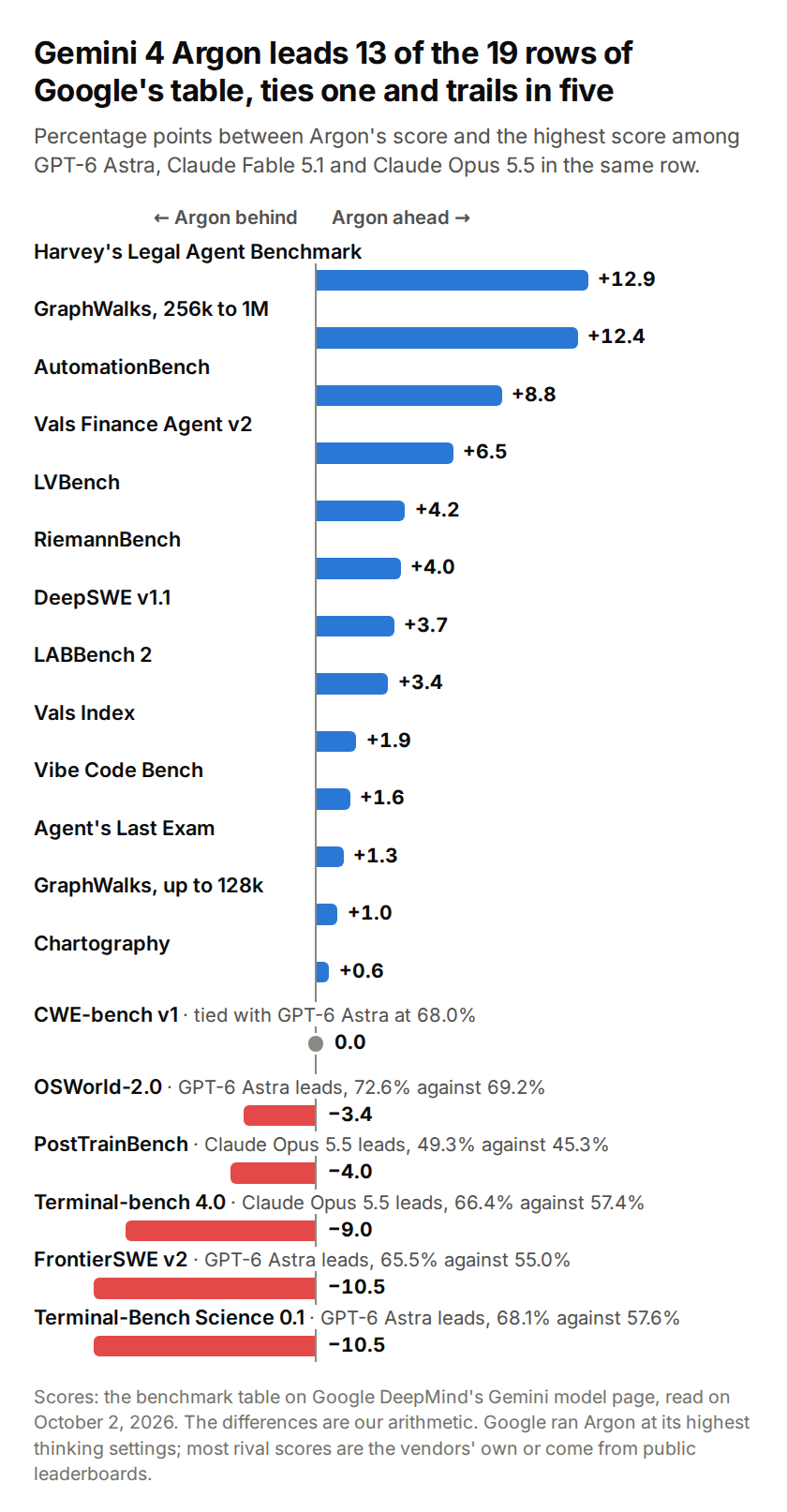
The two longest bars on the left are FrontierSWE v2 and Terminal-Bench Science 0.1. On each, Argon is 10.5 points behind GPT-6 Astra: 55.0% against 65.5%, and 57.6% against 68.1%.
The other three are Terminal-bench 4.0, where Claude Opus 5.5 leads by 9.0 points, PostTrainBench and OSWorld-2.0. On the right, Argon’s widest lead is 12.9 points, on Harvey’s Legal Agent Benchmark: 19.6% against Claude Fable 5.1’s 6.7%.
Two of the five are coding benchmarks. Google labels four of its rows agentic coding. Argon leads DeepSWE v1.1 with 77.9% and Vibe Code Bench with 91.9%, and it has the lowest of the four scores on FrontierSWE v2 and on Terminal-bench 4.0.
Advertisements
Google computed the Gemini 4 Argon score on DeepSWE itself
The 77.9% on DeepSWE v1.1 is Google’s own measurement. The methodology note says Google computed it “using a mini-swe agent harness” and took GPT-6 Astra’s 74.1% from the benchmark’s public leaderboard.
That leaderboard, run by Datacurve, was last updated on September 22, 2026 and has no Argon row. Each of its rows names the reasoning effort the model ran at, such as High or Max.
Gemini 3.8 Flash is on it at High effort, with 74%±1% for an average cost of $2.36. GPT-6 Astra is at Xhigh effort, with 74%±3% for $4.43. By our reading, the Gemini model already in the API matches GPT-6 Astra’s leaderboard score for about half the cost, $2.36 against $4.43.
Advertisements
Three leaderboards already price a Gemini 4 Argon run
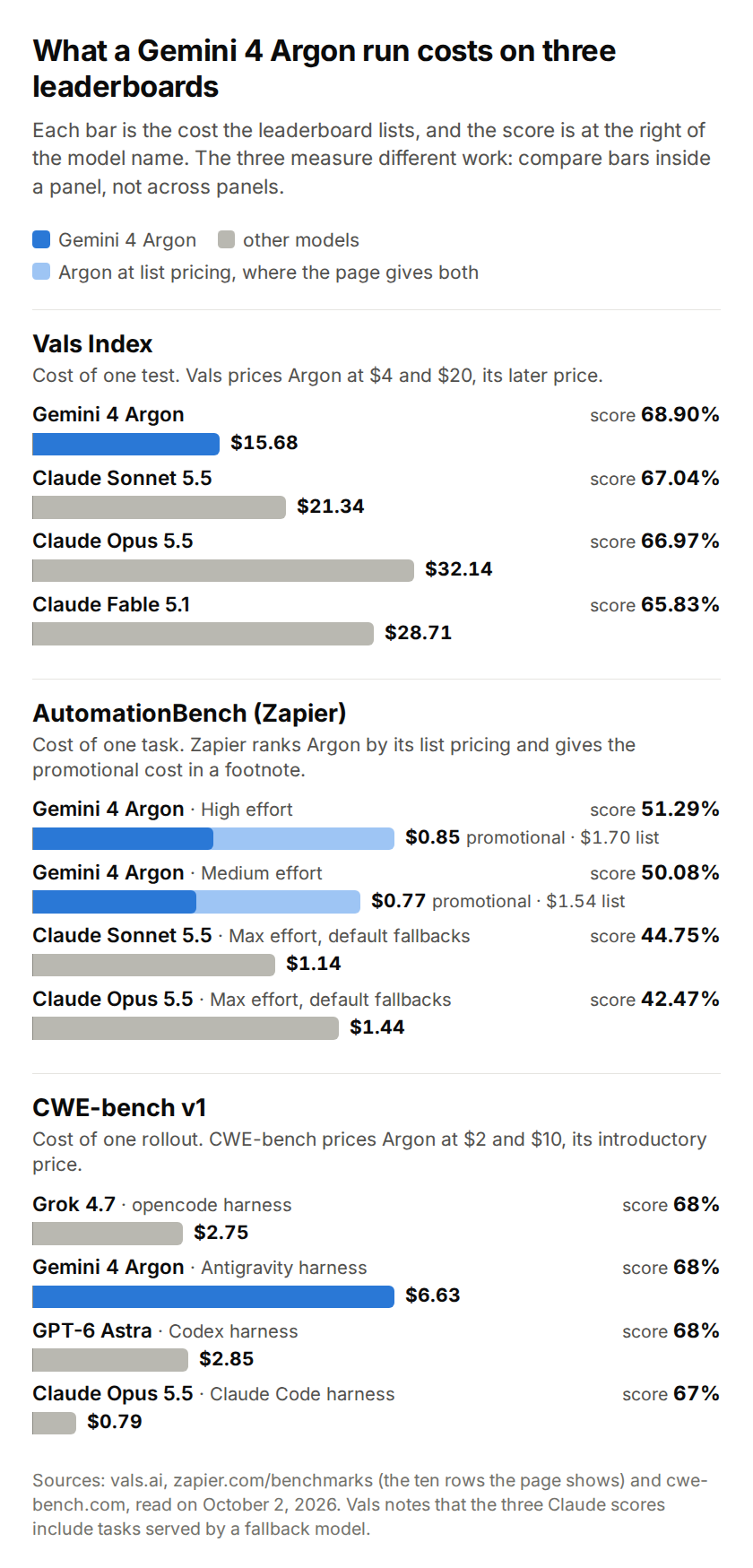
Google’s table has scores and no costs. We opened four of the leaderboards behind it: Zapier’s AutomationBench, DeepSWE and CWE-bench, which the methodology note links, and the Vals Index, which the announcement links. All but DeepSWE have an Argon row with a cost column.
The three measure different work, so their costs don’t compare with each other. AutomationBench scores agents on business workflows and reports the cost of a task. The Vals Index combines finance, coding, legal and tax tasks and reports the cost of a test.
CWE-bench has agents audit and patch code repositories. It reports the cost of a rollout, one attempt at one task, and names the harness, the agent program that drove each model.
Advertisements
On Zapier’s page the Claude rows carry the label “default fallbacks”, which means a step the model refused went to “the provider’s own default fallback model”.
The chart has one panel per leaderboard, with Argon’s rows and the rows around them. In each panel, compare the length of Argon’s bar, its cost, with the bars of the models that score closest to it. Every number is as the leaderboard lists it.
The three pages qualify their own numbers
Zapier’s page shows ten rows before a button that loads 111 more, and those ten are what we read. Its cost column uses list pricing for Argon, and a footnote gives the promotional cost as $0.85 a task at High effort. At Medium effort Argon scores 50.08% for $1.54 a task at list price.
Advertisements
Vals lists Argon at $4 and $20. It notes that the scores of Sonnet 5.5, Opus 5.5 and Fable 5.1 include tasks served by a fallback model, and that counting those tasks as failures lowers the scores to 65.85%, 65.05% and 64.59%, “with the order unchanged”. Its written takeaways still call Sonnet 5.5 and Opus 5.5 “effectively tied at the top”, although the table has Argon above both.
CWE-bench runs four rollouts on each of its 120 tasks, and the four models in the chart ran on four different harnesses. Its $6.63 is the cost at the introductory $2 and $10.
What the cost columns change
This part is our reading of those rows.
On the Vals Index, Argon is first and also the cheapest of the top four to run: $15.68 a test against $21.34, $32.14 and $28.71, at the $4 and $20 price. Sonnet 5.5 is the runner-up at 67.04%, or 65.85% without the fallback tasks, and it is a model Google’s table leaves out.
Advertisements
On AutomationBench, 6.54 points separate Argon at High effort from Sonnet 5.5 at Max effort, 51.29% against 44.75%. Which of the two is cheaper depends on the price. At list pricing a task costs $1.70 on Argon against $1.14 on Sonnet 5.5, and while the promotion lasts it costs $0.85 against $1.14.
On CWE-bench, three models share the top score and Argon costs the most of the three, $6.63 a rollout against $2.75 and $2.85. Opus 5.5 is one point lower, 67% against 68%, for $0.79. The harnesses differ, so each cost belongs to a model and its harness together.
Google has not given a date or an end to the introductory price
Google hasn’t said when paid API customers get Argon, when the introductory price ends or what cached input costs in dollars. The pages to watch are the Gemini API release notes and the DeepSWE leaderboard. The newest release note is still dated September 22, 2026, and the leaderboard has no Argon row to set beside Google’s 77.9%.
Advertisements
Related posts:
 Google Cuts One-Third of Managers in Move to Streamline Its Organizational Structure
 A New DeepSeek Paper Highlights the Growing Push for More Efficient AI Training
 OpenAI Launches ChatGPT Health: New AI Tool Focused on Healthcare with Reinforced Privacy
 Claude Cowork: Anthropic Introduces an AI Agent That Works Directly With Your Files
 Claude Opus 5.5 vs GPT-6 Sol and Luna: prices, benchmarks, platforms
 Claude Sonnet 5.5 vs Opus 5.5: cost per task, where each fits