English
Claude Sonnet 5.5 vs Opus 5.5: cost per task, where each fits

Claude Sonnet 5.5 costs exactly what Sonnet 5 cost, $2 per million input tokens and $10 per million output tokens. Anthropic released it on September 28, 2026, six days after Opus 5.5, as the second model of the Claude 5.5 family, and the announcement puts the saving elsewhere: the model needs fewer tokens for the same work, so a task costs “up to 30% less” than on its predecessor. GitHub Copilot, Amazon Bedrock including GovCloud, Vercel’s AI Gateway, Google Cloud and Microsoft Azure listed it the same day.
The announcement compares Sonnet 5.5 with Sonnet 5 and, in four charts, plots its cost per task against Opus 5.5 at every effort level. The charts have no table, so this piece reads the numbers out of them and puts the two models side by side.
It also adds a footnote the announcement leaves to the system card, lists the settings that turn working Sonnet 5 requests into errors, and gives the model ID on each platform. It follows up our comparison of Opus 5.5 with GPT-6 Sol and Luna, which ended with Anthropic’s promise that Sonnet 5.5 would follow in the coming weeks.
Advertisements
Same price as Sonnet 5, and the same cache read as Opus 5.5
The table lists the price per million tokens of the two Claude 5.5 models and of Sonnet 5, from the announcement, Anthropic’s pricing page and the guide to building with Sonnet 5.5 on Anthropic’s developer blog, which says every Sonnet 5.5 price, prompt caching included, matches Sonnet 5’s.
| Model | Input | Output | Cache read | Cache write, 5 minutes | Cache write, 1 hour |
|---|---|---|---|---|---|
| Claude Sonnet 5.5 | $2 | $10 | $0.20 | $2.50 | $4 |
| Claude Sonnet 5 | $2 | $10 | $0.20 | $2.50 | $4 |
| Claude Opus 5.5 | $4 | $20 | $0.20 | $5 | $8 |
The saving Anthropic claims is in token count: the model “typically needs far fewer tokens to do the same work”, and in Anthropic’s testing a task costs up to 30% less than on Sonnet 5. It also generates output “30%+ faster”, which Anthropic calls its fastest Sonnet to date.
The customer quotes on the page give that claim numbers, each measured by the customer named. Slack reports about 14% fewer output tokens on its Slackbot evals with unchanged prompts. Balyasny Asset Management reports about 121k tokens per answer on its suite of 2,441 finance tasks, where Sonnet 5 used 497k.
Advertisements
Base44 reports 3.6 iterations per app build on average against 7.7 for Opus 5, on 118 builds. Lovable reports a third fewer tool calls and roughly half the shell runs per task.
Below Sonnet 5.5 the family still has a gap. The current small model is Haiku 4.5, at $1 input and $5 output on the pricing page, with a retirement date not sooner than October 15, 2026, and the migration guide tells Haiku 4.5 users who move up to re-baseline cost “at the higher price per token”.
Images cost more on the way up too. Sonnet 5.5 uses the high-resolution image tier, and the migration guide says a 2000×1500 image costs about 2.5 times as many tokens as on Haiku 4.5.
Advertisements
The announcement does not comment on the cache read row, where Sonnet 5.5 and Opus 5.5 meet at $0.20, and a Hacker News comment asked about it within half an hour of the post.
Where Sonnet 5.5 costs less per task, and where Opus 5.5 at High beats it
Anthropic’s charts are indexed by effort, the five-step setting from Low to Max that tells the model how long to think before answering. The announcement plots score against cost per task for each level on four benchmarks, and Anthropic’s own summary is that Sonnet 5.5 “complements Opus 5.5 best when running at lower effort settings, where it costs less per task. At higher settings, it can perform comparably at a similar cost.”
The table gives the points behind that sentence for the two coding benchmarks, read from the chart data on the page. Terminal-Bench 4.0 runs multi-step tasks in a command line; FrontierCode v1.1 asks whether an agent’s code change would be merged as is. Each cell is the score and Anthropic’s cost per task at that effort level.
Advertisements
| Effort | Sonnet 5.5, Terminal-Bench | Opus 5.5, Terminal-Bench | Sonnet 5.5, FrontierCode | Opus 5.5, FrontierCode |
|---|---|---|---|---|
| Low | 20.0%, $0.76 | 38.5%, $1.29 | 29.3%, $0.19 | 47.3%, $0.40 |
| Medium | 28.8%, $0.83 | 57.6%, $2.94 | 36.5%, $0.24 | 54.6%, $0.80 |
| High | 43.0%, $1.94 | 64.2%, $3.88 | 49.4%, $0.42 | 54.0%, $1.09 |
| Xhigh | 61.5%, $5.30 | 66.4%, $7.35 | 52.1%, $1.59 | 51.4%, $2.25 |
| Max | 70.6%, $12.54 | 64.8%, $11.24 | 46.2%, $20.78 | 54.4%, $6.19 |
Read the Terminal-Bench columns in pairs, Sonnet 5.5 one level above Opus 5.5. At the bottom Sonnet 5.5 is cheaper and scores far less: Medium costs $0.83 for 28.8% where Opus 5.5 at Low costs $1.29 for 38.5%, and High costs $1.94 for 43.0% where Opus 5.5 at Medium costs $2.94 for 57.6%. The pair flips at the top: Sonnet 5.5 at Xhigh costs $5.30 for 61.5%, and Opus 5.5 at High costs $3.88 for 64.2%, less money for a higher score.
Only at Max does Sonnet 5.5 score above every Opus 5.5 point, 70.6% for $12.54, where Opus 5.5 at Max costs $11.24 for 64.8%.
FrontierCode is where Sonnet 5.5 has its cheap points. At High it scores 49.4% for $0.42 a task, about half of what Opus 5.5 at Medium costs for 54.6%, and Anthropic says that at this level it matches GPT-6 Sol’s best score “for about a fifth of the cost per task”. The Max column is the exception for Sonnet 5.5: it scores less at Max than at Xhigh and costs $20.78 a task.
Advertisements
The announcement’s second footnote attributes the lower score to the model more often running Claude Code’s code-review skill, which “splits the review across many subagents”, and in two cases examined by Cognition “led to a timeout or to extra edits beyond the task’s scope”.
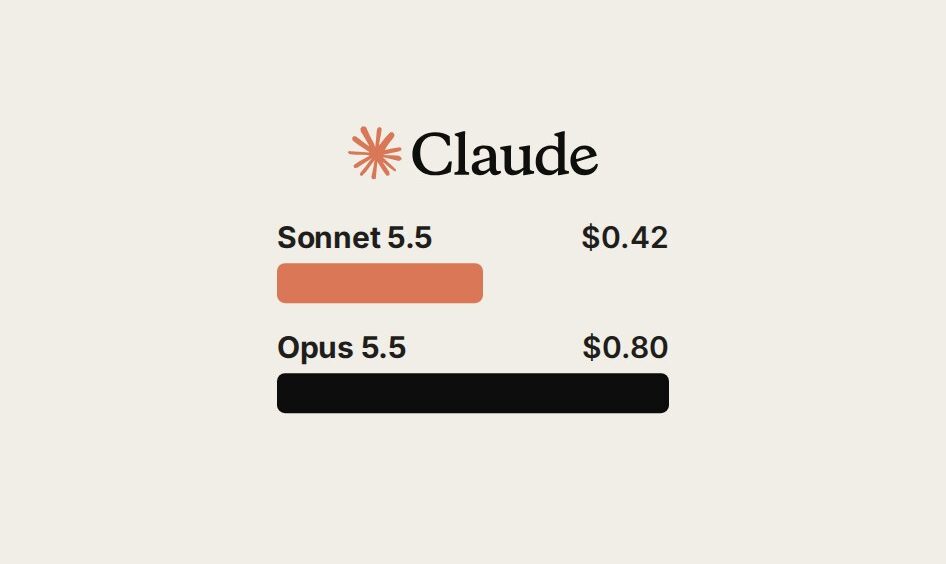
The defaults decide which of these points you land on. For Sonnet 5.5 the announcement gives Medium as the default in Claude Code and the Claude apps and High on the Claude Platform; Anthropic’s models overview lists Medium as the Platform default of Opus 5.5. So a Sonnet 5.5 run at its Platform default lands on the $0.42 point of Anthropic’s FrontierCode chart, and an Opus 5.5 run at its default on the $0.80 point, with about five points of score between them.
The levels are also recalibrated. The migration guide says a level “doesn’t produce the same amount of thinking as on Claude Sonnet 5” and tells Sonnet 5 users to re-run their effort sweep, so the table is Anthropic’s points per level, not where a Sonnet 5 setting lands.
Advertisements
The charts also plot an OpenAI model, and in two of the four it is GPT-5.6 Sol, not GPT-6 Sol. Anthropic’s note says Terminal-Bench and OpenAI “did not report GPT-6 Sol performance publicly”, so it plots the previous model there; the FrontierCode and AA-Briefcase charts use GPT-6 Sol, and all of those points are Anthropic’s reading of other people’s numbers.
The Terminal-Bench lead over Opus 5.5 comes with a fallback footnote
The headline number of the announcement is 70.6% on Terminal-Bench 4.0, against 10.3% for Sonnet 5 and 66.4% for Opus 5.5. A smaller model beating the larger one from the same family on the headline coding benchmark drew the question in the Hacker News thread, and one commenter found the answer in section 8.5 of the Sonnet 5.5 system card.
The system card says both scores were produced with safeguards enabled, and that requests the safeguards flagged were answered by a fallback model. For Sonnet 5.5 that was 1.2% of requests, “affecting 1.5% of trials”. For Opus 5.5 it was 2.5% of requests, “affecting 10% of trials”.
Advertisements
The card says the fallbacks followed “the default server-side fallback policy”, and Anthropic’s refusals and fallback page names Sonnet 5 as Sonnet 5.5’s fallback model under that policy, for the cyber and frontier_llm categories. Sonnet 5 scored 10.3% on the same benchmark.
Which category the flagged requests fell under, the card does not say, and for Opus 5.5 the page says the routing “is not published per model”.
The card puts the standard error, treating trials as independent, at ±2.5 points for Sonnet 5.5 and ±2.6 points for Opus 5.5, on five trials per task over 66 tasks.
Advertisements
The two scores are also at different effort levels. Sonnet 5.5’s 70.6% is at Max. Opus 5.5’s 66.4% is at Xhigh, “as in its own system card”, and the card adds that Opus 5.5 at Max scores 64.8%, “within noise of xhigh”.
On the same card’s Terminal-Bench-Science, where fallbacks “did not fire on any request or trial”, Sonnet 5.5 scores 59.9% and Opus 5.5 58.7%.
Anthropic’s own framing on the announcement page is that “Opus 5.5 remains clearly stronger at complex, open-ended work requiring sustained judgment”, in its testing and that of external testers, and that Sonnet 5.5 “doesn’t advance the frontier of our models’ capabilities”. What the announcement does not say, and the system card does, is that on a tenth of the Opus 5.5 trials at least one request was answered by another model, one Anthropic does not name.
Advertisements
Four settings from Sonnet 5 now return 400, and one change is silent
Anthropic’s migration guide opens with five settings that return a 400 error on Sonnet 5.5: thinking budgets, sampling parameters, assistant prefill, forced tool choice and thinking turned off. Prefill was already rejected on Sonnet 5, the guide says, and it files thinking budgets and sampling parameters under the changes for Sonnet 4.6 and earlier, so code that runs on Sonnet 5 today has dropped all three. Two are new for that code, two more breaking changes sit further down the guide, and one change returns no error at all.
Turning thinking off is the one the announcement itself flags. Sonnet 5 accepted thinking: {"type": "disabled"}; Sonnet 5.5 rejects it with the error "thinking.type.disabled" is not supported for this model. The replacement is between_tools, which keeps up-front thinking off and still returns thinking blocks between tool calls.
It works at Low, Medium and High effort and returns a 400 error at Xhigh or Max. A request that changes effort mid-conversation under it is rejected too.
Advertisements
Forced tool use is gone. A tool_choice of type any or tool returns tool_choice: type "tool" and "any" are not supported for this model, including on the token counting endpoint. The guide’s replacement is auto with the tool marked strict: true.
Amazon Bedrock is the exception: the guide says structured outputs, which include strict tool use, are not available for Sonnet 5.5 there, so the advice is auto alone and validation in your own code.
Further down the guide, computer use on the Claude API and Google Cloud works only through the computer_toolset_20260801 toolset; computer_20251124 returns a 400 error there and is still accepted on Bedrock. With the advisor tool, a Sonnet 5.5 executor rejects Opus 4.8, Opus 4.7 and Sonnet 5 as advisors, and the advice from an accepted one comes back encrypted.
Advertisements
The silent change is in thinking blocks. Sonnet 5.5 reads thinking blocks from Sonnet 5, Opus 4.8 and Haiku 4.5, but not from Opus 5, Opus 5.5 or any Fable or Mythos model. The API drops the blocks it cannot read, returns 200 and does not bill them. The other direction is closed too: the developer guide says “No other model reads Sonnet 5.5’s blocks”, and the Opus 5.5 migration guide says only Claude Fable 5.1 and Claude Mythos 5.1 read Opus 5.5’s.
Each Sonnet 5.5 thinking block is signed over the conversation before it: for accounts created on or after August 31, 2026, a request that replays a block after an edit to earlier history returns 400, so the guide’s instruction is to keep conversations append-only.
The model ID has no date, and Copilot is rolling it out gradually
Sonnet 5.5 has no dated model ID, and Bedrock and Vercel prefix the name in their own way. The identifiers below come from the models overview, the AWS announcements for Bedrock and GovCloud (US), the Bedrock model card, Vercel’s changelog and GitHub’s changelog.
Advertisements
| Where | Identifier | Notes |
|---|---|---|
| Claude Platform | claude-sonnet-5-5 | No date suffix; 1M-token context, 128K output, June 2026 knowledge cutoff; default effort High; zero data retention available |
| Amazon Bedrock, including GovCloud (US) | anthropic.claude-sonnet-5-5, global profile global.anthropic.claude-sonnet-5-5 | Also through Claude Platform on AWS, Anthropic’s own platform billed by AWS; no structured outputs |
| Google Cloud | claude-sonnet-5-5 | |
| Microsoft Foundry | claude-sonnet-5-5 | Global Standard deployments only; the announcement calls the platform Microsoft Azure, and the ID and the Foundry name are from the models overview |
| Vercel AI Gateway | anthropic/claude-sonnet-5.5 | Zero Data Retention supported |
| GitHub Copilot | model picker | Pro, Pro+, Max, Business and Enterprise plans, in ten surfaces from VS Code to Xcode; rollout is gradual |
| Claude apps and Claude Code | Sonnet 5.5; the sonnet alias from Claude Code v2.1.284 | Default effort Medium; in Claude Code thinking cannot be turned off, there is no fast mode, and the default model stays Opus 5.5 |
Copilot Business and Enterprise administrators control access through the model policy, and GitHub says new models are enabled by default unless an administrator has turned that off. Anthropic lists the retirement date as not sooner than September 28, 2027.
What this means if you pay for Claude tokens
For a coding agent the bill is mostly cache reads: Anthropic’s Opus 5.5 announcement says they “make up the majority of agentic and coding work costs”. Sonnet 5.5 reads cache at the same $0.20, so switching an agent from Opus 5.5 to Sonnet 5.5 saves on output, on input and on cache writes, and nothing on the row that dominates a long session. The claimed saving is in tokens per task, and that is the number no source measures against Opus 5.5: Anthropic’s “up to 30% less” is against Sonnet 5, and of the thirteen customer quotes on the page, none gives a token count against Opus 5.5.
Two details from the developer guide weigh on that row. Changing the top-level effort between requests invalidates the cache, and only per-message effort, in beta, keeps it. The minimum cacheable prompt drops to 512 tokens, from 1,024 on Sonnet 5, so shorter system prompts and tool definitions now qualify.
Advertisements
By Anthropic’s own points, Sonnet 5.5 is the cheaper choice at Low and Medium effort, and on FrontierCode at High. On Terminal-Bench at Xhigh it costs more than Opus 5.5 at High, $5.30 against $3.88, for a lower score, and its Max point, $12.54, costs more than every Opus 5.5 point, the highest of which is $11.24. That is the case for Sonnet 5.5 as the model for well-scoped work at default effort, which is also how Anthropic describes it, and against running it at Xhigh or Max to close the gap.
The developer guide says the same: at those levels Sonnet 5.5 thinks longer and costs more, you may lose “its balance of quality, speed, and cost”, and “In that case, consider Opus 5.5”.
Two community measurements point the same way. In the Hacker News thread, Simon Willison reports that at Max effort Sonnet 5.5 spent 128,000 thinking tokens and 15m 40s, at $1.28, without producing the SVG, while Low and Medium used 0 thinking tokens. Another commenter reports that on their own adversarial benchmark Sonnet 5.5 scored 7.4% against 17.8% for Sonnet 5, because it stopped to ask the user whether to keep going.
Advertisements
One migration detail weighs on the pairing that more than one commenter in the thread proposes, Opus 5.5 as the orchestrator and Sonnet 5.5 as the sub-agent: Sonnet 5.5 cannot read Opus 5.5 thinking blocks, Opus 5.5 cannot read Sonnet 5.5’s, and the API drops them silently. Hand-offs between the two have to carry text in both directions, not thinking.
Two numbers are still missing: whether Sonnet 5.5 needs fewer tokens than Opus 5.5 on the same task, which only an independent run can give, and the price of Claude Haiku 5.5, due “in the coming weeks” by Anthropic’s account. When either lands, the Claude tag of our News section is where it goes.
Related posts:
 Claude Cowork: Anthropic Introduces an AI Agent That Works Directly With Your Files
 Claude Opus 5.5 vs GPT-6 Sol and Luna: prices, benchmarks, platforms
 A New DeepSeek Paper Highlights the Growing Push for More Efficient AI Training
 OpenAI Launches ChatGPT Health: New AI Tool Focused on Healthcare with Reinforced Privacy
 GPT-6.1 Sol: what changed from GPT-6 Sol and what a task costs
 Gemini 4 Argon: announced at $2 and $10, not in the API yet